THE MASTING AND RIGGING OF SHIPS
INTRODUCTION
It should come as no surprise that the greater part
of a book written on the rigging of ships is devoted to vessels propelled
solely by sail. The Introduction that follows is not intended to be a historical
treatise on the development of vessels from antiquity to the present time.
Rather, its purpose is to identify some of the factors that have caused rapid
technological change in shipbuilding and the effect they have had on the
various shipbuilding trades. Since the introduction of iron and steel,
shipyards building in wood have been in decline; with those building sailing
vessels exclusively being the first to go.
The
iron steamer Great Britain of 1845 introduced the screw propeller as a
propulsive device for ocean‑going vessels. This ship, of length 88 m
(288.7ft), breadth 15.5 m (50.9ft) and draught 5.49 m (18.0ft), marked the
beginning of a whole new era in steam navigation at a time when wooden
shipbuilding had reached its zenith.
During
the first half of the last century the Americans gradually drifted away from
the old traditions by constructing their ships larger and with finer lines than
ordinary merchant vessels. Built using an abundant and cheap resource of timber, these so-called 'clippers'
soon became celebrated and favoured everywhere due to their great capacity and
speed. It was only a matter of time before other nations began constructing
similar large wooden vessels for their own merchant fleets.
A
scarcity of suitable timber in Britain prompted British shipbuilders to pursue
the construction of steamers and
sailing vessels from iron at an early stage. By 1837, the first iron ocean‑going
vessel, the Rainbow, was already in service. A major problem with iron
in the early days was that the immersed hull quickly became heavily fouled with
marine growth; particularly when journeying in warmer waters. Such was the loss
in speed due to fouling that, initially; some reservations were expressed as to
the suitability of iron vessels for extended voyages. Certainly, their
performance compared poorly with copper‑sheathed wooden vessels, where
the fouling of the sheathing was negligible, even after long periods at sea.
By the 1860's the above objections to iron had led the British to develop so‑called 'composite' vessels in which the transverse and primary longitudinal members as well as the diagonal tie‑plates were made of iron and the shell and deck were timber planked. Expensive to construct, these vessels were planked with high quality timbers such as teak and sheathed in copper. From 1864 on, composite vessels were awarded the highest classification from Lloyds—that of 20 years—due to the reduced risk of fouling which dogged iron vessels.
A
number of composite vessels were constructed specifically for the tea trade
between China and Britain. These 'tea clippers' were built for speed to achieve
quick passages both out and home again. Over the years a keen rivalry developed
between the vessels in this trade. This culminated in the never‑to‑be‑forgotten
race between the clippers Ariel, Taitsing, Taeping, Serica
and Fiery‑Cross. The first three‑named vessels were
composite‑built while the other two were wooden. All were of modest
dimensions by today's standards—under 60 m (196.9 ft) in length and 900 tons
gross.
The famous clippers of the 1850's and 60's engaged in
the Australian trade sailed outbound in ballast carrying passengers. Being
favourably laden, these vessels were able, on occasion, to achieve passages
superior to those of modern sailing vessels. Thermopylae, for example,
took 61 days from The Channel to Melbourne. Today a passage of 70 to 90 days is
regarded as being very good—remembering, of course, that this is for a vessel
heavily laden.
On the continent wooden vessels continued to be built
in numbers—timber being not as scarce there as it was in Britain. The
exceptions were the Dutch, however, who constructed most of their vessels for
the colonial trade using the composite system.
Deep‑sea sailing vessels of the past carried
large crews to handle the extensive sail plans characteristic of the times,
studdingsails included. With such a large area of sail, these vessels were able
to make good passages in light airs. Subsequent innovations such as double
topsails and various ingenious patented methods for self‑reefing topsails
were introduced with the aim of reducing the number of crew required. Some
sailing vessels were even fitted with auxiliary screw propulsion.
While improvements were being made to the design and
construction of sailing vessels, progress was also being made in the science of
navigation. Closer attention was given to the statistical observation of sea
conditions, wind strength and direction, temperature and barometric pressure
prevailing at various parts of the oceans throughout the four seasons. Using
this information, the optimum routes, both outbound and home, could be
determined for any time of year. If a planned course deviated greatly from the
normal routes, the duration of the voyage could still be reduced by combining
astute observation with a knowledge of the local meteorological conditions to
meet with fair winds.
As suitable anti‑fouling compositions for
coating ship's bulls were developed, iron sailing vessels became more and more
popular.
At the same time that improvements were being made to
the design and operation of sailing vessels, steamers were also evolving. The
big advantage of self‑propelled vessels was, of course, their ability to
steer a direct course from part to port, independent of the direction and
vagaries of the wind. This enabled costs to be lowered. Sailing vessels
continued to remain competitive in the longer trades, however, because the
crude machinery of early steamers consumed vast quantities of coal.
The opening of the Suez Canal in 1869 shortened the
voyage between Europe and India, East Africa and Australia. Via the canal,
ordinary tramp steamers could now make such voyages in 30 to 40 days. Sailing
vessels were excluded from any benefit, however, and so a major portion of the
trades that had once belonged to them was lost.
The
result of the various developments described above was that the composite
system in new construction gradually fell into decline. Nowadays, apart from
some naval cruisers and pleasure vessels, this form of construction is only
occasionally still used, mainly in the United States and Sweden.
As early as the middle of the last century, the German
seaports of Hamburg and Bremen operated well-established sailing ship fleets.
Among the more important trades was the carriage of emigrants from Europe to
various American destinations. In 1847 the "Hamburg‑Amerikanische
Paketfahrt‑Aktien‑Gesellschaft" was founded, inaugurating its
passenger services in wooden vessels. By 1856, the company had introduced its
first steamer, the Borussia, into regular service. She was soon to be
followed by the Hammonia and others. The company 'Norddeutsche Lloyd'
began operations in 1858 with the introduction of four steamers Bremen, New
York, Weser and Hudson. Initially, both steamship companies
faced many difficulties. As well as each company losing a ship by fire; vessels
of both frequently sustained considerable damage through the rigours of
service.
These mishaps, when added to other expenses, permitted
sailing vessels to remain competitive against steamers in the emigrant trade.
Even as late as the mid 1870's, newspapers in the abovementioned German parts
still advertised "the most renowned, fast‑sailing, copper fastened
and sheathed, vessel
Baltimore,
….."
It was inevitable, however, that this trade, once so
lucrative for sailing vessels, would be lost—not because of some radical innovation
or event, but merely through the steady improvement of steamers and their
machinery. It is not difficult to understand why emigrants favoured steamers
over sailing vessels. The arrival of the steamer at its destination was fixed
to within a reasonable" degree of certainty. As the importance placed on
quick passages increased, so‑called *express" steamers became more
and more popular. These vessels were able to charge a premium for the shorter
passage, even though less of the fare went toward the price of provisions. The
premium even extended to steerage passengers.
The carriage of emigrants by sail has long since
ceased. It was fortunate that none of the shipping companies collapsed;
probably due to the introduction of modern cargo carrying sailing vessels. Of
about 1000 tons gross and 7 to 8 metres (23‑26 ft) draught, these vessels
helped regain much of the ground previously lost.
A
different story can be told for the carriage of cargo, however. For decades
steamers have competed with sailing vessels without being able to oust the
latter from the seas. Large sailing vessels carrying bulk cargoes such as rice,
coal, saltpeter, guano and cased petroleum, deep‑sea via Cape Horn and
the Cape of Good Hope have retained much of their former share of the market.
Intermediate‑sized vessels, however, have not fared so well despite not
having to transfer cargoes to and from smaller vessels, lighters, etc. Small
vessels still find employment in the local coastal and tidal flats trades,
notwithstanding the increase in lighterage operations. The one time profitable
carriage of petroleum in barrels has long since passed to the modern tanker.
Steel as a shipbuilding
material for merchant vessels began
to make an appearance in the early 1890's. Although initial acceptance of steel
was slow, the development of cheaper and better methods of manufacture,
together with the reduction in scantlings permitted by its greater strength,
resulted in the eventual widespread use of the new material. The following
table compiled by Lloyd's Register lists the shipping of the world during the
final decade of the last century. The trend toward the increased use of steel
is clearly illustrated.
The table includes all vessels of 100 tons and over
(gross tonnage for steamers and net tonnage for sailing vessels). The figures
apply to the twelve months between July and June the following year.
Referring to rows 2 and 7 of the table, it is clear
that the advantages of reduced hull weight and correspondingly greater
deadweight capacity which accompanied the use of steel were more quickly
exploited in steamers than in sailing vessels.
As already mentioned, the composite system soon became
obsolete for the construction of merchant vessels. In Europe, iron and wood are
also falling into disuse as shipbuilding materials due to the greater weight
and, in the case of wood, smaller volumetric capacity and relatively shorter
working life of vessels so built. In America, the land of forests, wooden
shipbuilding is still practised. The enormous size of wooden vessels
constructed there can be gauged from the particulars of the four‑masted
barque Roanoke. Launched in 1892, Roanoke has a length overall of
100.88 m (331.0 ft), length of keel 94.8 m (311.0 ft), beam 15.0 m (49.2 ft),
draught 8.23 m (27.0 ft) and deadweight of 5000 tonnes. The Americans have also
built a number of large five‑ and six‑masted schooners, and even a
seven-master. Among these, completed at the beginning of this century, are the
following:
‑ two six‑masted schooners, George W. Wells
and Eleanor A. Percy of length 100 m (328.1 ft), beam 14‑15
m (45.9‑49.2 ft) and depth 7‑7.5 m ( 23.0‑24.6
ft).
‑ the steel seven‑masted schooner Thomas
W. Lawson of length 123 m (403.5 ft), beam 15.24 m (50.0 ft), depth 10.46 m
(34.3 ft) and tonnage 5218 gross.
The decline in the numbers of wooden ships can be seen
in rows 4 and 9 of the table. This can be directly attributed to the decline in
American shipbuilding.
Rows 5 and 10 clearly illustrate the steady increase
in the average tonnage of ships, particularly that of steamers. The downward
trend in the total tonnage of sailing vessels during the final decade of the
last century is shown in row 10 of the table.
A list of German registered merchant vessels of a
gross tonnage over 50 m3 (141.5 GRT), compiled in the first half of 1902 from
the quarterly statistics of the German Empire dated 1st January
1901, contained 3883 vessels totalling 2,826,400 tons gross and 1,941,645 tons
net. Of theses 2493 were sailing or non-propelled vessels totalling 640,510
tons gross and 593,770 tons net. Steamers amounted to 1390 vessels of 2,185,890
tons gross and 1,347,875 tons net. Analysis of the sailing and non-propelled
vessels listed in the above‑mentioned
statistics reveals 45 vessels with four or more masts, 296 three‑masters,
1377 two‑masters, 552 single‑masters and 223 non‑propelled
barges without any masts except those for working cargo. Included among the
vessels with four or more masts was the Hamburg registered five‑masted
barque Potosi of 4026 tons gross—at that time the largest sailing vessel
in the world. (Presently, the
five‑masted fully rigged ship Preussen of 5081 tons gross holds
this title).
|
|
|
1890/91 |
1891/92 |
1892/93 |
1893/94 |
1894/95 |
|||||
|
No. |
Hull Material |
No of Ships |
Tonnage |
No of Ships |
Tonnage |
No of Ships |
Tonnage |
No of Ships |
Tonnage |
No of Ships |
Tonnage |
|
Steamers |
|||||||||||
|
1 |
Iron |
7606 |
8252841 |
7531 |
8058848 |
7439 |
7914687 |
7238 |
7661124 |
7099 |
7432890 |
|
2 |
Steel |
2941 |
5145588 |
3516 |
609411 |
3943 |
6918215 |
4502 |
7986235 |
4994 |
9038000 |
|
3 |
Composite |
152 |
42873 |
148 |
41429 |
162 |
46555 |
164 |
58424 |
156 |
65170 |
|
4 |
Wood |
1006 |
375207 |
998 |
363315 |
1014 |
364961 |
1003 |
360419 |
1007 |
360911 |
|
5 |
Total Steam |
11705 |
13816509 |
12193 |
14562003 |
12558 |
15264418 |
12907 |
16066202 |
13256 |
16887971 |
|
Sailing Vessels |
|||||||||||
|
6 |
Iron |
1824 |
1963109 |
1807 |
1924915 |
1762 |
1879185 |
1703 |
1814267 |
1671 |
1778671 |
|
7 |
Steel |
349 |
512865 |
598 |
916683 |
681 |
1028118 |
759 |
1142750 |
801 |
1185101 |
|
8 |
Composite |
136 |
99488 |
125 |
91154 |
122 |
87735 |
115 |
83839 |
114 |
82123 |
|
9 |
Wood |
18312 |
6547987 |
17343 |
6199753 |
16887 |
5998919 |
15237 |
5462438 |
14526 |
5173766 |
|
10 |
Total Sail |
20621 |
9123449 |
19873 |
9132505 |
19452 |
8993957 |
17814 |
8503294 |
17112 |
8219661 |
|
11 |
Grand Total |
32326 |
22939958 |
32066 |
23694508 |
32010 |
24258375 |
30721 |
24569496 |
30368 |
25107632 |
|
|
|
1895/96 |
1896/97 |
1897/98 |
1898/99 |
1899/1900 |
|||||
|
No. |
Hull Material |
No of Ships |
Tonnage |
No of Ships |
Tonnage |
No of Ships |
Tonnage |
No of Ships |
Tonnage |
No of Ships |
Tonnage |
|
Steamers |
|||||||||||
|
1 |
Iron |
6959 |
7186852 |
6865 |
6935067 |
6735 |
6664283 |
6502 |
6194102 |
6262 |
5915714 |
|
2 |
Steel |
5525 |
10137431 |
6102 |
11253129 |
6702 |
12417281 |
7507 |
14254522 |
8286 |
15999406 |
|
3 |
Composite |
166 |
63321 |
168 |
64124 |
180 |
67341 |
193 |
69885 |
192 |
72107 |
|
4 |
Wood |
1002 |
350221 |
1048 |
354292 |
1084 |
362387 |
1122 |
359237 |
1158 |
382131 |
|
5 |
Total Steam |
13652 |
17737825 |
14183 |
18606612 |
14701 |
19511292 |
15324 |
20877746 |
15898 |
22369358 |
|
Sailing Vessels |
|||||||||||
|
6 |
Iron |
1608 |
1714593 |
1546 |
1649509 |
1500 |
1601677 |
1439 |
1532511 |
1386 |
1482388 |
|
7 |
Steel |
841 |
1241569 |
875 |
1306876 |
913 |
1369118 |
1000 |
1421014 |
1082 |
1509298 |
|
8 |
Composite |
105 |
73845 |
96 |
67409 |
95 |
64767 |
88 |
58802 |
86 |
55193 |
|
9 |
Wood |
13674 |
4846257 |
11651 |
4277045 |
10843 |
4014396 |
10329 |
3783455 |
9970 |
3627491 |
|
10 |
Total Sail |
16228 |
7876264 |
14168 |
7300839 |
13351 |
7049958 |
12856 |
6795782 |
12524 |
6674370 |
|
11 |
Grand Total |
29880 |
25614089 |
28351 |
25907451 |
28052 |
26561250 |
28180 |
27673528 |
28422 |
29043728 |
Many merchant vessels of the past
were rather inefficient and poorly suited
to the particular trades in which they were engaged. Instead of having to be
competitive, the shipowners
relied heavily upon various trade monopolies and other like
restrictions. Today the situation has
changed greatly. For a vessel to continue to trade today, it must maintain a
clear economic advantage over its competitors. The greater this advantage, the
lower the freight rates that can be offered and the greater the chance of the
vessel securing a cargo. As well as being sufficiently strong and long‑lasting,
such vessels must combine a large carrying capacity with adequate speed and
manoeuvrability, while at the same time requiring only minimum crew. If lighterage charges are to be avoided,
allowance must also be made for any restrictions in draught at the intended ports of call.
As a general observation, the majority of sailing vessels
have a hull form that is both pleasing and serviceable. This is in stark
contrast to a number of modern, flat‑floored steamers seen today which
have a totally utilitarian form and rig—as though the designer had an extremely
pronounced taste for the unaesthetic. Although the rig of steamers must satisfy
a number of important practical requirements; it is usually possible to also
design the rig with a reasonably handsome appearance.
Unlike steamers, it is not normal to subdivide the
internal volume of sailing vessels by bulkheads into separate watertight
compartments. Instead, there is usually just a single large hold that, in
larger vessels, is divided horizontally by a tween deck. In the absence of a
tween deck, deep web frames and stringers are installed; these having
superseded the old system of hold beams.
All sailing vessels are provided with at least one
collision bulkhead forward. In many cases, another similar bulkhead is
installed aft. Further subdivision of the hold of sailing vessels by bulkheads,
in the manner usual on steamers, tends to hinder the loading and unloading of
cargo. Furthermore, the safety of the vessel is not significantly increased
because, as a compartment floods, the vessel sinks almost to deck level,
reducing the stability beyond the paint where capsize occurs. Large four‑
and five‑masters are often fitted with either hold beams or structural
bulkheads immediately abaft each mast in order to strengthen the transverse
structure and support the large cargo hatches.
The deck erections on large four‑ and five‑masters
usually consist of a foc's'le, a short poop and. an the largest vessels, a
bridge deck or "Liverpool" house spanning from gunwale to gunwale for
accommodating the crew. Where a Liverpool House is fitted, the steering gear and a chart house are located on the deck above in a manner
similar to steamers.
Smaller four‑masters and large three‑masters
are usually arranged with a foc's'le and long poop in the
traditional manner. The poop contains the cabin and staterooms, while a large
deckhouse abaft the foremast serves to house the crew. The galley and
accommodation for petty officers are either in the deckhouse already referred
to, or in a separate smaller deckhouse. Small vessels have a raised quarterdeck
over the cabin, with the remainder of the crew accommodated in a foc's'le or
house on deck.
The majority of French sailing vessels built in recent
years have very long deck erections, leaving only a short well deck amidships.
Not meant for the carriage of cargo, these extra large deck erections are
fitted in order to maximize the gross tonnage, while not effecting the net
tonnage‑ the objective being for the ship owner to take full advantage of
the French Government's system of shipbuilding and voyage bounties.
A number of modern sailing vessels have been equipped
with stockless anchors. Although lacking the holding power in all conditions of
the ordinary stocked anchor, stockless anchors have been in use for some time
on steamers. The efficiency of the ground tackle is of paramount importance on
sailing vessels because, unlike steamers, they are unable to use engines in
order to relieve the ground tackle in critical situations.
The trend in rigging has been toward simplification.
Studdingsails, patent self‑reefing sails, etc. have long been discarded
owing to the additional maintenance they require. Long jibbooms have given way
to shorter spike bowsprits where the jibboom and bowsprit are combined in a
single spar. The size of headsails has been reduced to the minimum possible in
order to reduce the risk to the crew when making these sails fast. Double
topsails are now universal, while double topgallants are common on larger
vessels. On some larger vessels, even the royals have been omitted entirely.
Special hand or steam winches are provided on large vessels for hoisting upper
topsail and upper topgallant yards. Additional smaller winches are fitted at
the rails for hauling the sheets of courses.
Large masts, yards, bowsprits and other spars are
constructed of iron or steel. Smaller spars are hewn from solid timber.
Normally, the standing rigging is made of steel wire rope set up with rigging
screws.
The preceding has been a brief overview of the
development of the sailing vessel during the latter half of the last century.
Attention will now be turned to examining some of the factors that have led to
the loss of several sailing vessels.
As already noted, the recent trend is for the size of
vessels to increase. With steamers, the upper limit of size has not yet been established.
Larger and larger steamers continue to be built. On the other hand, several
authorities believe that the upper limit of size for sailing vessels has been
reached and that, in fact, a few vessels may have already exceeded it. To date,
the largest sailing vessels have a tonnage of only 4000 to 5000 tons gross; all
of these being operated by the firm of F. Laeisz of Hamburg.
The major disadvantages of
such very large sailing vessels have been an increase in the problems encountered
when manoeuvring and a greater demand for qualities of leadership and skill on
the part of the master. As a result, many ship owners have been reluctant to build vessels any larger
than the largest three-masters. While there can be no doubt that a three‑master,
in particular a barque, will be much more handy than a four‑ or five‑master;
it should be recognized that nowadays large ships are rarely required to
manoeuvre in narrow channels, due to the almost universal availability of steam
tugs.
In order to provide a degree of independence from tugs
and the capability of proceeding through extended calms, a few experimental
sailing vessels have been fitted with an auxiliary steam engine and propeller.
Most have been unsuccessful. The firm of Rickmers Reismuhlen, Rhederei und
Schiffbau installed a 750 indicated horsepower engine in their five‑master
Maria Rickmers. When fully laden in calm conditions, the machinery gave
this vessel a speed of 5 to 6 knots. Due to the two entirely independent means
of propulsion—sails and propeller—auxiliary sailing vessels are inherently
safer and more manoeuvrable than ordinary steam or sailing vessels.
Unfortunately, Maria Rickmers went missing before sufficient experience
was gained with this type of equipment. Recent attempts at fitting auxiliary
machinery to small sailing vessels—schooners and fishing vessels—have
apparently met with encouraging results.
The frequent casualties involving large three‑
and four‑masted sailing vessels have resulted in considerable criticism,
both during the first half of the last decade and also recently. It is
therefore well worthwhile to examine closely the circumstances that led to
these casualties—at least as far as is possible from the scant accounts
available. Often, these mishaps were to influence later sailing vessel design.
In the past, mishaps involving sailing vessels were
fairly equally distributed among nations. Of late, however, French ships seem
to have suffered the most frequent casualties.
The earlier Incidents to large sailing vessels will be
considered first. Dismasting, either total or partial, occurred on the four‑masters
Wanderer, Australia and Somali. The four-master Govanbank
was abandoned off Cape Horn after having sustained damage to her rigging.
Another four‑master, Thracia, capsized with 600 tonnes of ballast
while under tow by a steamer, even though she had no sail set at the time. The
four‑masters Nation, Ben Douran, Govanburn, Dunkerque,
Caracas, Perseverance and the five‑master Maria Rickmers
all went missing. Of the last‑named group, all were fully laden with
the exception of Perseverance. She was in ballast—comprising 613 tonnes
of water ballast with an additional 250 tonnes of stone ballast stowed above
the double bottom. Both Govanburn and Dunkerque carried cargoes
of coal. Conceivably, their loss was due to either explosion or spontaneous
combustion. Improper stowage of ballast
was the cause of the Thracia's capsize. The first four-mentioned were probably
lost due to excess stability (i.e. being too stiff due to poor stowage), a
weakness in the rig or poor seamanship.
Of the seven vessels that
went missing, four carried water ballast in double bottom tanks. The adoption
of water as ballast has significant advantages over solid ballast; the costs of loading and discharging ballast
being avoided. Water ballast contained within double bottom tanks has been
commonplace on steamers for some time. Similar arrangements for ballasting
sailing vessels have not proven entirely satisfactory for a number of reasons.
First, the volume of water ballast contained within double bottom tanks is
usually insufficient to achieve a minimum practical sailing draught. Second,
vessels with a double bottom are likely to have a comparatively higher centre
of gravity of the deadweight when in the fully laden condition. This is because
the bottom of the hold on a vessel fitted with a double bottom lies
comparatively higher in the hull than on a vessel with a single bottom having
the ceiling laid directly over the floors. Thus, when in the laden condition,
vessels fitted with a double bottom tend to be more tender. A third problem
arises in the ballasted condition where the low centre of gravity of the
ballast in the double bottom can cause the vessel to be crank (ie. too stiff).
The first problem can be partially overcome by
stowing sand or stone ballast on top of the inner bottom, additional to the
water ballast. Even given the extra ballast stowed higher, it is likely that
the total centre of gravity of the ballast will still lie too low in the ship.
In the fully laden homogeneous cargo condition,
vessels fitted with a double bottom carry less cargo due to the reduced volume
of the hold and the additional weight of the double bottom itself. Moreover,
less sail can be set, because of the higher centre of gravity of the cargo. If
sail area is not to be sacrificed then the double bottom tanks must be at least
partially, if not completely filled, thus reducing the cargo deadweight even
further.
A continuous double bottom running fore and aft over
the whole length of a vessel can be advantageous—in the event of stranding for
instance. However, with the various drawbacks discussed above being so marked,
it is generally conceded that double bottom tanks are not a particularly
satisfactory solution to the ballasting requirements of sailing vessels. On the
other hand, double bottoms are almost indispensable in steamers where the
boilers, machinery and coal all contribute to give a high centre of gravity.
The double bottom ballast more than compensates for the high centre of gravity
of steamers in the unladen condition. While the consequences of excess
stability on steamers are minimal, the same characteristics on sailing vessels
can be highly detrimental due to the increased risk of dismasting.
With the increasing size of steamers, it was soon
found that water ballast contained within the double bottom tanks alone was
insufficient to achieve the required minimum ballasted draught. Nowadays, large
steamers are also provided with additional tanks, in the form of wing tanks
extending from the double bottom to the deck above, tween deck tanks or deep
tanks. The last‑named are not new. As early as 1873, steamers were being
constructed with deep tanks. Among them, the large steamers MINERVA and CERES
built by A‑G Weser of Bremen. Experience has since verified the
usefulness of deep tanks on steamers.
A number of sailing vessels have also been fitted with deep tanks extending
from the top of the inner bottom to the tween deck. As well as achieving the
required minimum draught. this arrangement results in a more favourable centre
of gravity. When not used for ballast, the deep tanks can be utilized to carry
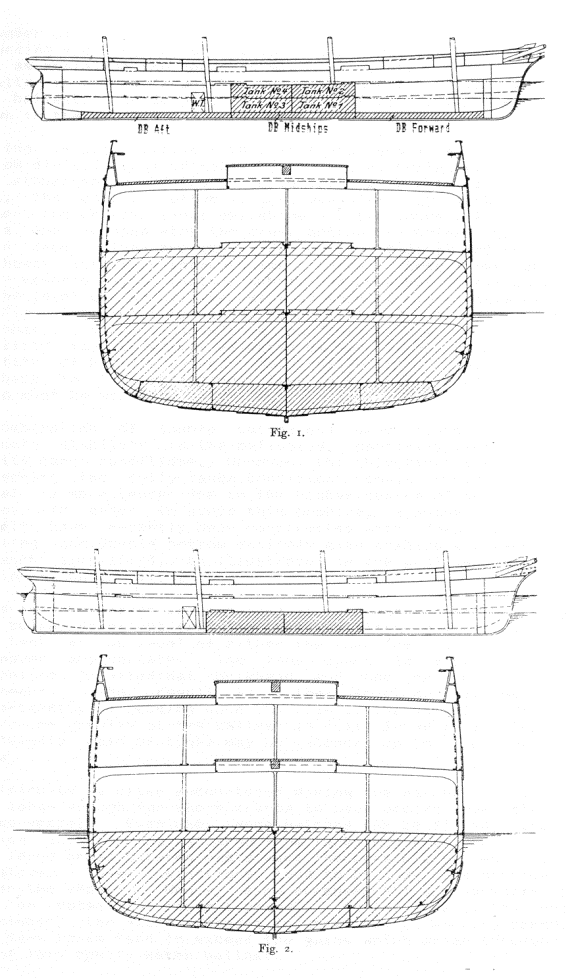
cargo, as shown in the profile and cross‑section given in Fig. 1.
Sailing
vessels fitted with deep tanks usually have the double bottom divided
longitudinally by a vertical centre keelson plate and athwartships by two or
three transverse watertight floors. Thus, the double bottom is arranged with
two tanks forward, either two or four tanks amidships and two tanks aft. The
deep tanks are located atop the inner bottom and extend up to the tween deck.
They are subdivided by longitudinal and transverse bulkheads into four separate
large tanks. Deep tanks on very deep vessels may be further subdivided by a
horizontal partition at the level of the hold beams; thus forming eight tanks
as shown in Fig. 1. These tanks are numbered 1, 2, 3 or 4, port or starboard.
When laden with a low-density cargo, the vessel's stability may be easily
adjusted by simply taking on a small quantity of ballast water. Notwithstanding
the advantages, a drawback to this arrangement lies in the many tanks from
which cargo must be worked.
A combination of double bottom and deep tanks can
provide adequate stability in the ballasted, partially laden and low-density
cargo conditions. However, the objections already stated concerning the fully
laden condition remain ‑ viz., that the vessel is more tender due to the
higher centre of gravity of the cargo. In order to avoid this problem, a number
of sailing vessels have recently been constructed with deep tanks only.
Omitting the double bottom entirely also enables the tankage to be much
simplified, as illustrated in the profile and cross-section shown in Fig. 2.
Transverse bulkheads are provided at each end of the
tank space. The bulkheads extend from the bottom plating up to the crown of the
tank at the level of either the tween deck or hold beams, whichever applicable.
A centreline longitudinal bulkhead and one or two transverse bulkheads
subdivide the tank space. The result is either four or six watertight
compartments, depending upon the size of the vessel. If the centre of gravity
of the ballast is still found to lie too low, the middle pair of tanks may be
extended up to the next deck above.
A difficulty is often encountered making the hatches
to each deep tank large enough for shore cranes to have access from both sides of
the vessel. Even when large hatches can be fitted, problems loading and
discharging cargo from tanks may still arise due to the large areas between
masts made inaccessible by shrouds and backstays. These objections tend to be
less of a problem the bigger the vessel. Hence, such arrangements are normally
only seen on vessels of large tonnage. As the size of the vessel diminishes,
the extra expenses incurred due to working cargo in the many tanks tend to
exceed the gains that arise through the use of less costly water ballast.
The master of a vessel arranged for water ballast does
not have the same discretionary control over the stability of his vessel, as
would otherwise be the case if solid or cargo ballast were loaded. On a water ballasted vessel it is the shipbuilder who must assume
responsibility for ensuring appropriate trim and stability in the ballasted
condition. The ballast tanks must contain sufficient water to achieve the
required minimum ballasted draught. Furthermore, the ballast water must be
properly distributed to ensure its centre of gravity is located at the
appropriate height. If double bottom tanks are to be fitted, a check should be
made to ensure adequate stability in the fully laden homogeneous cargo condition
with double bottom tanks empty.
It goes almost without saying that vessels carrying
water ballast must be provided with an auxiliary boiler and steam pumps.
When comparing the various options for ballasting
available, it should be noted that solid ballast avoids any risk of cargo being
spoilt by tanks leaking. Moreover, in certain trades, the vessel may well be
able to procure a small general or other suitable return cargo of sufficient
quantity to serve as ballast.
Recent years have seen the partial or total dismasting
of a number of large French sailing vessels. Among them were the barques Emilie
Galline, Grand Duchesse Olga, Marechal de Turenne, Marechal
de Villars, Max, Normandie, Paris and Seine.
Another, the Bretagne, foundered off Cape Horn due to dismasting and
rudder damage. Ville de Dyon was towed into Montevideo dismasted and in
a leaking condition. The barques Geneviena Melinos, Marie Melinos,
Vendee and the four‑masted barques Emilie Siegfried, Ernest
Siegfried, President Felix Faure and Ville du Havre all
sprung leaks at sea. Both Emilie Siegfried and Ville du Havre had
a gross tonnage exceeding 3000 tons. The remainder were between 2000 and 3000
tons. Vessels less than 2000 tons or greater than six years old have been
excluded from this discussion. President Felix Fauvre was built in 1896
while the others were built in the years 1898, 1899 and 1900. All were
constructed subsequent to the French bill of January 1893 that introduced
shipbuilding and voyage bounties. With this bill came a whole new generation of
large French sailing vessels. Some 60 to 70 in number, they differed little in
construction from other already well‑proven vessels. There appears to be
a correlation between many of the mishaps which befell this, class and the provision
of water ballast tanks and various other innovations. No indication could be
found to show that the type of cargo was a factor. Though two of the leaking
vessels and one of those dismasted were loaded with ore cargoes, the remainder
were loaded as follows: five with coal, four with general cargo and one with
grain. It has been established that none of the vessels laden with coal was
lost through spontaneous combustion. Neither the dimensions nor proportions of
these vessels were extraordinary. Other nations operate vessels of similar
tonnage without incident, indicating that size was not a factor. Generally, the
workmanship used in the construction of these French ships has been sound.
In the absence of the above possibilities, the greater‑than‑average
number of mishaps to French ships can probably be attributed to one or more of
the following:
‑ flaws in the design of the vessel and/or its
rig combined with an excessively large sail plan
‑ poor
stability characteristics caused by improper loading
‑ poor judgement on the part of the master together with other manning deficiencies.
The
first is entirely dependent upon the original design drawings that,
unfortunately, are not available for scrutiny. Similarly, the second cannot be
verified without access to the findings of the various inquiries. While one
might expect that manning should not be a problem, it is conceivable that the
boom in French sailing fleets could have led to a shortage of experienced
masters, officers and crew.
When designing a sailing vessel, it is crucial to
ensure that the sail area is properly proportioned relative to the size and
form of the hull. When this is achieved, the vessel will sail well without
requiring constant tending by her crew. Often an oversized rig is fitted in the
expectation that this will increase the speed or, at least, result in smarter
passages. Such assertions are erroneous in most cases. The author has analysed
the rigs of a number of speedy vessels renowned for their fast passages. None
were particularly heavily rigged. Other vessels with a comparatively larger rig
did not perform as well.
Obviously, a vessel that is excessively rigged must be
sailed with more caution and a larger crew than a vessel that has a rig in
proportion to its size and stability.
For the rig of a vessel to be optimised, spar sizes
should be kept within the limits nominated in this book. The latter have been
determined empirically from the analysis of a large number of successful
sailing vessels.
Although operational aspects fall outside the scope of
this work ‑ this being really the concern of the master ‑ a brief
mention is appropriate in so much as they require the cooperation of the
shipbuilder.
The master of a vessel loaded with a low density or
general cargo may need to stow a quantity of ballast beneath the cargo in order
to ensure adequate stability. Often, the quantity of ballast required is not
easy to determine, particularly if the cargo in question has not been carried
before. Cases arise where even the most experienced seamen have had difficulty
assessing how a vessel will behave at sea. The larger the vessel, the more
difficult this becomes. With small vessels, the characteristics may be
determined intuitively from the vessel's "feel". The same techniques
are not readily applicable to larger vessels.
The master carries a heavy responsibility for both the
lives of all those aboard and a valuable cargo. He should, therefore, be well
versed with the concepts of stability; preferably through formal study at a
school of navigation. Armed with this knowledge, the master should be
sufficiently competent to independently perform an inclining experiment and
then apply the results. To assist the master of a larger vessel in his
investigation of the stability, the shipbuilder must provide the necessary
curves, tables and drawings. The builder should also furnish a statement of the
permissible values of metacentric height through the range of draughts. The
stability of a vessel should be investigated over the range of loading
conditions, viz., for a variety of cargoes and draughts and when ballasted. A
number of loading combinations may need to be calculated before adequate
stability is attained.
Already, some knowledgeable circles believe that it will
only be a matter of time before sailing vessels disappear entirely from the
world's oceans. One can only hope that this will not be the case. There is
still much scope for potential improvement in the efficiency of sailing
vessels; both by means of new innovation and reductions in operating costs.
Inevitably, steamers will also undergo further development; at least partially
counteracting any potential gains made through the improvement of sailing
vessels. Analysis has shown that the annual operating costs of the more common
sailing vessel types are approximately 25% of the initial purchase price. This
is about 30% less than the figure for steamers. Moreover, while fuel costs for
steamers will steadily increase, the motive power for sailing vessels, the wind,
will forever remain free.
While a decline in sailing vessel numbers is already
apparent in the merchant fleets of the world; interest in sailing for sport is
increasing. In Germany, this has been largely due to the example set by our
Kaiser. Recently, the Grand Duke of Oldenburg has sponsored the construction of
a number of school ships for the training of young seamen. In France, sailing
vessels continue to be heavily subsidized by the government. These developments
are mainly due to the correct realization that sailing vessels are and will
always remain the ultimate school for seamen.